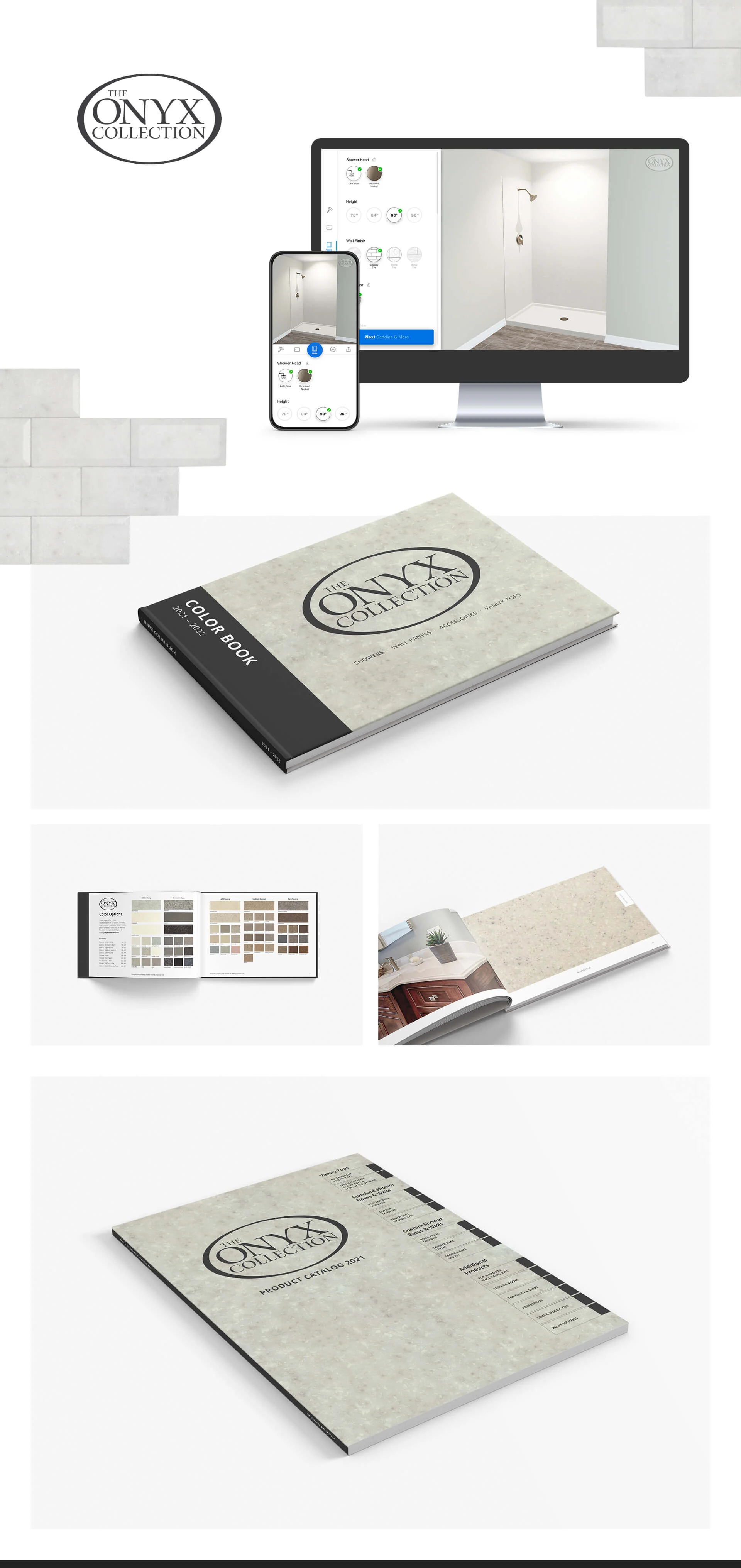
Onyx Shower Designer
Project overview
Project: Interactive 3D Shower Designer — in-showroom touchscreen app for visualizing and configuring custom showers
Role: Senior UX Designer — led research (including field studies), interaction & 3D UX design, prototyping, usability testing, and handoff
Timeline: 8–10 weeks (research → prototype → pilot → roll‑out)
Team: Product Owner, Visual Designer, 3D Developer, Front-end Dev, Sales Lead, Showroom Staff
Context Onyx sells custom showers. Customers hesitated to commit to full remodels because they couldn’t visualize finished results in their space. Sales stalled in showrooms where customers needed confidence, scale, and realistic previews to move forward.
Problem
High purchase hesitation and long decision cycles in the showroom.
Sales staff spent excessive time manually demonstrating options.
Lack of a low-friction tool to explore configurations, pricing, and manufacturability in real time.
Goals & success metrics
Increase showroom conversion rate by 30–50%
Increase average order value by 20–35%
Reduce time-to-decision by 40%
Improve showroom engagement and sales throughput
Research approach (with field studies)
Field studies: 10+ in-showroom observations during peak hours across multiple locations; ride-alongs with sales staff to watch real customer interactions and decision moments.
Contextual interviews: showroom customers (prospective buyers) and sales associates.
Usability testing: iterative 3D prototypes with showroom visitors and staff.
Analytics: tracked in-app events (config starts, saves, shares) and showroom sales KPIs during pilot.
Key field-study insights
Real decision blockers surfaced in-situ: customers needed scale, tactile finish references, and rapid visual iteration while standing in the showroom.
Sales behavior: associates used physical samples and hand sketches, which limited throughput and made parallel sales difficult.
Social decision-making: customers frequently consulted partners in-store; shareable configs and immediate print/email summaries were highly valuable.
Starter presets were essential: most customers preferred selecting a curated style and then customizing, rather than building from scratch.
Design solutions
Large-touchscreen 3D app: place a scaled shower in a room, drag/drop components, change finishes, and view orthographic and perspective previews.
Preset-led flow: three curated starting styles (Classic, Modern, Luxury) to reduce paralysis, with instant live pricing and manufacturability checks.
Showroom interaction patterns: quick-demo “sales mode” and collaborative mode for multi-person sessions.
Share & continue: immediate email/share with encoded config, photos, and pricing for at-home decision-making.
Sales enablement: 2–3 minute demo script, staff training, and quick reference cards based on field findings.
Onboarding & fallback: preset templates and a fast reset/undo to recover from exploratory sessions.
Prototyping, testing & pilot
Built 2D clickthroughs → lightweight 3D prototype → production app.
Iterated with showroom participants; refined touch targets, camera presets, and pricing visibility based on observed behaviors.
Pilot deployed on a 55–75" touchscreen with trained staff and tracked engagement → conversion metrics.
Measured outcomes (pilot → roll‑out)
Showroom conversion rate: +48% within 90 days
Average order value (AOV): +28%
Time-to-decision: −42% median reduction
Engagement: avg session time = 7.5 minutes; 65% of sessions saved/shared
Sales throughput: +35% more booked projects per showroom day
Pilot ROI: ~4.5x within 12 months
Deliverables
Field study notes, observation clips, and synthesis
Interactive touchscreen prototypes and production UI specs
3D asset guidelines and price-rule integration spec
Usability test report with prioritized fixes (field-validated)
Staff training materials and quick-start script
Analytics event map and KPI dashboard
Learnings & impact
Field studies were critical to uncovering real showroom behaviors and designing interaction patterns that match in-person decision moments.
Preset-led, touch-first 3D configuration with live pricing reduces anxiety and accelerates commitment.
Shareable outputs extend decision momentum beyond the showroom and increase remote conversion.
Short, field-informed staff workflows allow associates to run fast demos and support multiple customers concurrently.