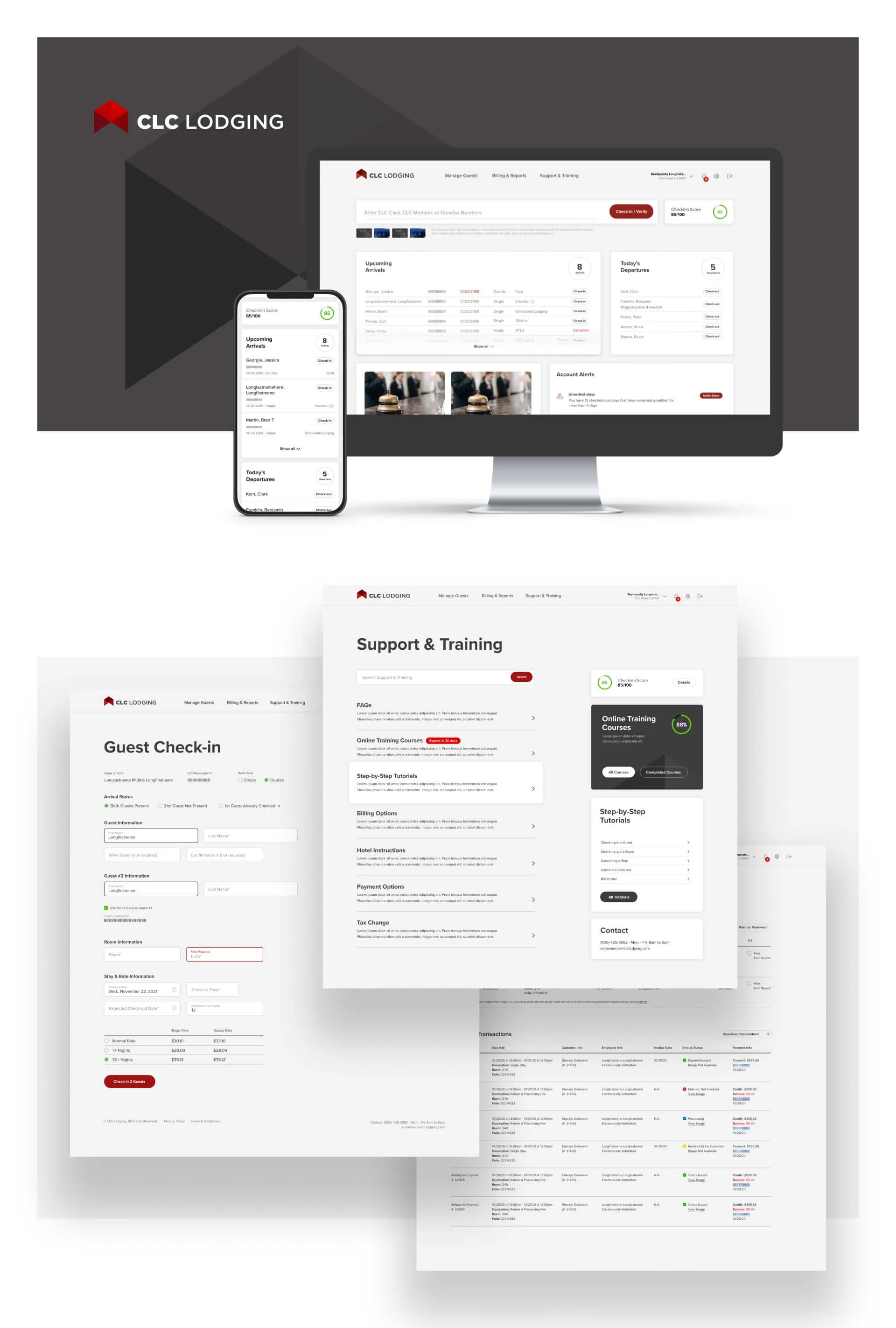
CLC Lodging Hotel Portal
Project overview
Project: Product & website design — lodging management product (use‑case-driven flows and marketing pages)
Role: Senior UX Designer — led research, service design, interaction design, prototyping, usability testing, and handoff
Timeline: 8 weeks
Team: PM, Product Manager, Content Strategist, Front‑end Dev, Sales SME, Customer Success
Context CLC Lodging helps companies manage business travel lodging. Many organizations (construction, field services, sales teams) faced hidden costs and chaotic processes because employees independently book hotels for convenience and price, producing inconsistent billing, invoice errors, and poor policy compliance. The company needed clear product flows and messaging to surface cost savings, compliance controls, and a frictionless booking experience.
Problem
Hidden lodging costs across teams (out-of-policy bookings, variable rates, invoice errors) eroded margins.
Decentralized booking caused bookkeeping chaos and manual reconciliation work for finance teams.
Prospects couldn’t quickly see how CLC reduced costs and simplified operations.
Existing flows didn’t guide travel bookers or managers through policy-compliant booking and approvals.
Goals & success metrics
Reduce out-of-policy bookings by 40% within 90 days of product/flow launch
Decrease lodging-related invoice reconciliation time by 50%
Increase demo requests from target verticals (construction, field services) by 30%
Improve booking completion rate by 25%
Deliver production-ready UX artifacts for engineering and marketing
My approach
Stakeholder alignment
Workshops with Sales, Finance, Customer Success to surface cost drivers, reconciliation pain points, and required reporting.
UX research
Contextual interviews with 10–12 users: travel bookers, finance leads, field managers (including "Pat" — CEO of a mid-sized construction firm).
Service-mapping sessions to document current booking → expense → reconciliation flows and failure points.
Synthesis & personas
Created 4 personas: CEO (cost owner), Travel Booker, Finance Reconciler, Field Employee. Mapped goals, pain points, and decision criteria.
Journey & IA
Built an end-to-end journey: Search/Policy → Book → Approve (if needed) → Invoice & Reconcile → Reporting.
Prioritized microflows: guided booking (policy-first), approval routing, consolidated invoicing, and automated reconciliation.
Prototyping & testing
High-fidelity web and mobile prototypes; moderated usability tests (8–10 participants) focusing on booking, approvals, and reconciliation tasks.
Iterate & handoff
Prioritized fixes, produced UI components, API data needs, reporting specs, and analytics event map.
UX Research — methods & key findings Methods
Contextual interviews: 10–12 participants across roles
Service mapping & process workshops with Sales/Finance
Moderated usability testing: 8–10 participants on high-fidelity flows
Analytics baseline review (booking completion, policy violation rate)
Key findings
Hidden-cost dynamics: employees book for convenience; many small deviations add up to major expense and admin burden.
Pain for finance: hundreds of small invoices, manual corrections, and missing project attributions create significant reconciliation time.
Decision drivers: concrete savings estimates, consolidated invoicing, audit-ready reports, and an easy booking experience for field staff.
Booking friction: strict policy enforcement that blocks choices reduces adoption—users preferred soft guidance + easy override/approval.
Trust signals: case-savings examples, clear policy summaries, and an invoice-preview increased manager buy-in.
Design solutions
Policy-first booking UI: visible policy status, suggested compliant alternatives, and one-click request-for-approval when out-of-policy.
Consolidated invoicing flow: auto-grouped charges by project/department with a single monthly invoice download for finance.
Automated reconciliation tools: match bookings to project codes and auto-flag anomalies for review; CSV export and accounting system integration.
Manager dashboard: summary of cost savings, pending approvals, and policy adherence rates with drilldowns.
Buyer-facing marketing pages: hero copy focused on “cut hidden lodging costs” with an ROI calculator and demo CTA.
Progressive onboarding: quick setup for policy rules, project codes, and preferred hotels to reduce initial admin lift.
Measured outcomes (targets / pilot results)
Out-of-policy bookings: −42% within 90 days (pilot clients)
Invoice reconciliation time: −55% in pilot accounts (automation + consolidated invoice)
Booking completion rate: +27% after UI improvements to guidance and override flow
Demo requests from target verticals: +33% via ROI-driven landing pages
Projected annual cost savings: example ROI calc showing 2.8x program ROI in 12 months for medium construction firm
Deliverables
High-fidelity desktop & mobile prototypes (Figma)
Journey maps and service blueprint (booking → invoice → reconcile)
Persona pack and prioritized feature matrix
UI component library and API/analytics spec
Usability test report with prioritized fixes
Marketing landing copy and ROI calculator spec
Handoff package: dev tickets, acceptance criteria, and integration notes
Impact & learnings
Balancing enforcement with flexible approvals preserves user adoption while reducing costs.
Consolidated invoicing is a high-leverage feature for finance teams; simplifying billing drastically reduces reconciliation time.
ROI-focused marketing (savings calculator + case snapshots) converts better for cost-conscious verticals.
Early integration planning with accounting systems avoids later development bottlenecks.