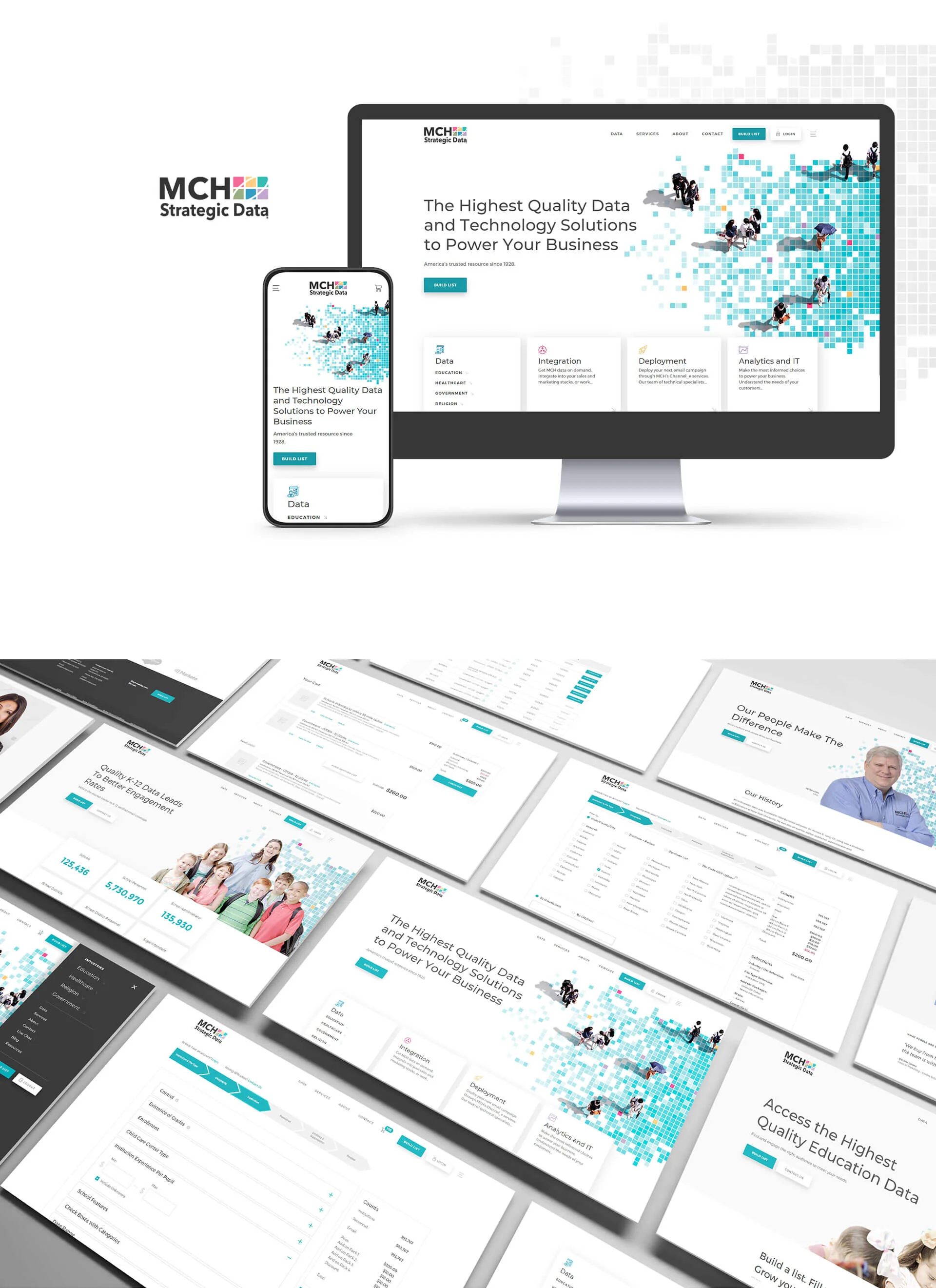
MCH Strategic Data
Project overview
Project: Website redesign — vertical landing pages + one‑page solution briefs for Education, Healthcare, Government, and Religious sectors
Role: Senior UX Designer — led research, information architecture, interaction design, prototyping, usability testing, and handoff
Timeline: 8 weeks (research → prototype → test → iterate → launch)
Team: PM, Content Strategist, 4 Vertical Sales SMEs, Front-end Developer, Analytics Engineer
Context MCH Strategic Data (MCH) — Founded 1928, Sweet Spring, MO — positions itself as solution architects and trusted advisors that help clients harness data, analytics, and technology. Despite deep vertical data and full‑stack services (data + deployment + analytics + enterprise IT), MCH’s messaging and site experiences didn’t surface vertical value quickly. Prospects struggled to understand outcomes and convert into qualified leads across target markets (Education, Healthcare, Government, Religious).
Problem
Visitors couldn’t find vertical-specific value fast enough.
CTAs underperformed and lead forms created friction.
Marketing lacked concise, measurable proof points to demonstrate ROI to prospects.
Goals & success metrics
Increase MQLs by 30% within 90 days
Improve MQL→SQL conversion from 14% → 22%
Reduce Education CPL by 40%
Improve CTA click-through by 25%
Deliver prioritized, production-ready design artifacts
My approach
Stakeholder alignment
Interviewed Sales, Marketing, Ops, and Compliance to map goals, constraints, and required trust signals.
User research
Recruited buyers across four verticals for qualitative interviews and moderated usability tests on prototypes.
Synthesis & personas
Built 4 buyer personas (Education Admin, Healthcare Program Lead, Gov Procurement Officer, Faith Org Director) and a prioritized messaging matrix.
IA & content strategy
Designed vertical-first page flow: hero (problem + metric) → features → proof points → one-page brief CTA → single-step pilot request modal.
Prototyping & testing
Delivered high-fidelity mobile and desktop prototypes; ran moderated usability tests (5–7 participants per vertical).
Iterate & handoff
Prioritized fixes, produced design system snippets, publish-ready copy, PDF brief templates, and coordinated analytics tracking.
UX Research — methods
Stakeholder interviews: 6 internal stakeholders
Buyer interviews: 20 total (5 per vertical), 30–45 min semi-structured
Moderated usability tests: 24 participants (6 per vertical), task-based on high-fidelity prototypes
Live A/B tests: hero headline and CTA variants on two pilot pages
Analytics & heatmaps: GA4 + Hotjar monitoring first 30 days
Key findings
Decision criteria: demonstrable vertical experience, compliance assurances (Healthcare/Gov), fast time-to-value, and clear KPIs.
Language mismatch: buyers respond to outcome-focused language (“reduce CPL”, “qualified decision-makers”) rather than product lists.
Trust anchors: short, visible metrics and downloadable one-page briefs increased intent to contact.
Form friction: multi-field forms lost ~45% of visitors; single-step modal with progressive profiling significantly improved completion.
CTA expectations: first-click testing showed CTAs should be in the hero or immediately below proof points.
Design solutions
Hero-first pattern: concise problem statement + one-line outcome metric + verticalized CTA.
Proof placement: metric and 2-sentence case highlight directly under hero for immediate trust.
Single-step pilot modal: minimal required fields (name, company, role, campaign goal, budget range) with follow-up via nurture.
One-page downloadable briefs: Challenge → Solution → Results → Next Steps with clear KPIs.
Accessibility & compliance: visible privacy and compliance notes for Healthcare and Government pages.
Measured outcomes (pilots & early rollouts)
MQLs: +35% in 90 days (pilot pages)
MQL→SQL conversion: 22% (up from 14%)
Education CPL: −40% after list validation + targeted deployment
CTA CTR: +28% for selected hero CTA variants (A/B tests)
Campaign response rates: +18% vs legacy lists (email & direct mail)
Revenue uplift: +25% from existing accounts via packaged analytics + deployment upsells over 6 months
Client retention: +15% year-over-year after adopting outcome-focused packages
Pilot ROI: 3.2x return within 12 months (pilot program projection)
Deliverables
High-fidelity desktop & mobile prototypes (Figma)
Vertical persona pack and messaging matrix
Landing page templates and publish-ready copy blocks
One-page PDF brief templates (print-ready)
Usability test report with prioritized fixes
A/B test plan and analytics event map for GA4
Handoff package: component specs, accessibility notes, and dev tickets
Impact & learnings
Outcome-first messaging (metric + problem) drove trust and faster buyer decisions.
Reducing lead-form friction through progressive profiling improved conversions without compromising qualification.
Early collaboration with Sales and Compliance ensured landing pages contained the right trust signals for sensitive verticals.
Integrating analytics from day one enabled rapid validation and iteration of design decisions.