McElroy’s
Project overview
Project: Website redesign — reposition McElroy’s to drive credibility and local project growth in Kansas City & Lawrence
Role: Senior UX Designer — led discovery, user research, information architecture, interaction design, prototyping, usability testing, and dev handoff
Timeline: 8 weeks
Team: PM, Content Strategist, Account Manager, Front-end Dev, Sales/Estimator SMEs
Context McElroy’s is a regional mechanical/engineering contractor targeting commercial, construction, service, and residential clients. The existing website did not convey credibility or make it easy for prospective local clients to find project examples, service details, or request estimates — limiting inbound project leads in the KC/Lawrence market where McElroy’s aimed to expand.
Problem
Site did not communicate immediate credibility or local presence.
Prospects couldn’t easily discover relevant services or recent projects.
Contact and lead-capture paths were weak, causing missed opportunities for growth in KC/Lawrence.
Competitive landscape included established regional firms (US Engineering, P1 Group, Midwest Mechanical).
Goals & success metrics
Increase qualified local project inquiries in KC/Lawrence
Improve site-driven lead conversion rate (target +30% within 90 days)
Shorten contact-to-estimate time via clearer request flows
Surface portfolio by sector (Commercial, Construction, Service, Residential)
Approach / process
Stakeholder alignment
Workshops with leadership, sales/estimators, and operations to define success criteria, local targets, and technical constraints.
User & market research
Competitive audit of regional contractors, stakeholder interviews, and quick user interviews with local facility and property managers.
Content audit of existing pages, portfolio images, and case materials.
Synthesis & personas
Built 3 primary personas: Commercial Buyer (facility manager), Contractor Partner (GC/PM), and Residential/Service Owner — mapped needs and decision criteria.
IA & content strategy
Reworked information architecture: industry-focused entry points (Commercial / Construction / Service / Residential), project case studies, service landing pages, and local credibility pages (KC & Lawrence).
Created lead paths: estimate request, project inquiry, and phone-first CTA for urgent service.
Interaction design & prototyping
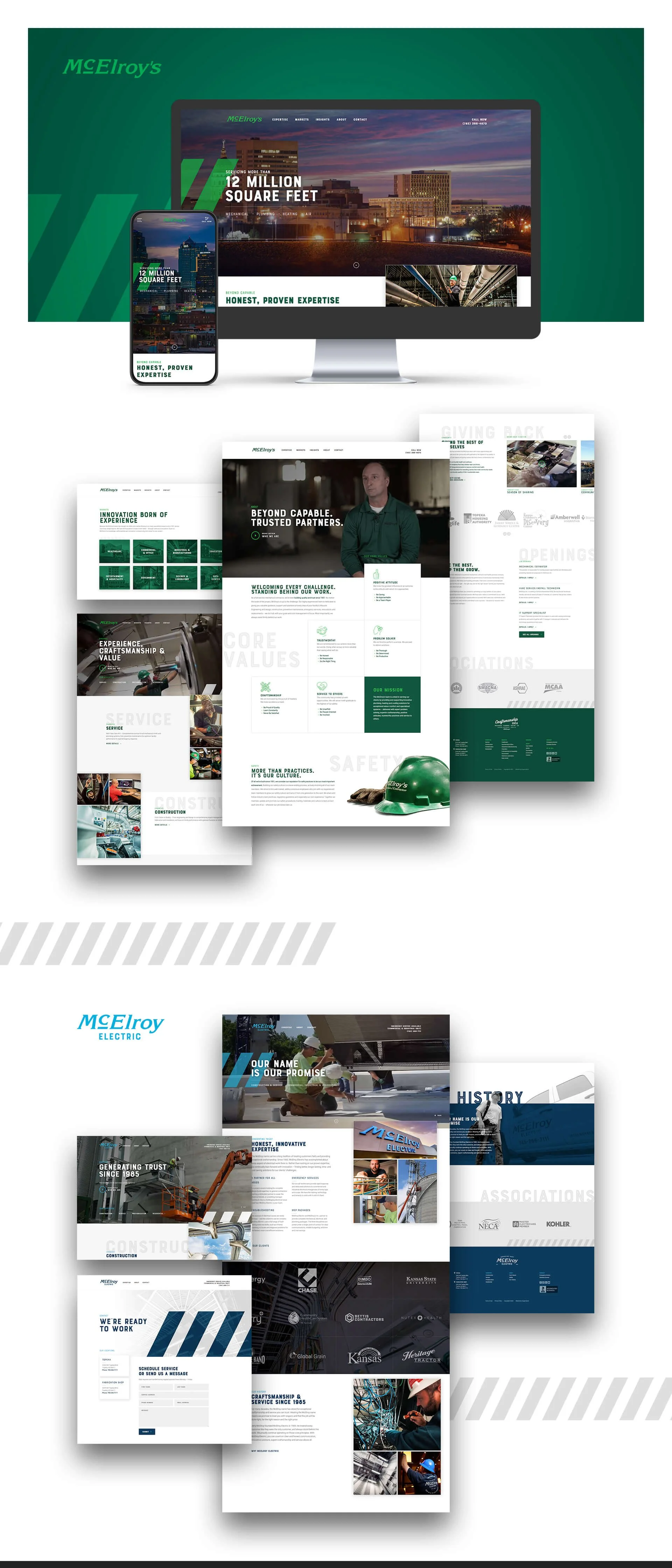
Designed homepage hero (local credibility + trust badges), service pages with clear benefits and scope, project detail templates (problem → solution → outcome), and simplified estimate form (progressive profiling).
Usability testing & iteration
Moderated tests on prototypes (5–7 participants from target segments) to validate findability, trust signals, and form flows.
Handoff & measurement
Delivered publish-ready copy blocks, templates, component specs, and analytics event map (lead sources, form completions, phone CTA taps).
Key design solutions
Local-first hero: “Serving Kansas City & Lawrence” with recent project thumbnails and trust cues (licenses, associations, client logos).
Industry entry points: four primary paths (Commercial, Construction, Service, Residential) driving tailored content and case studies.
Project case template: short project summary, technical scope, outcomes (schedule, cost savings), and contact CTA.
Lightweight estimate flow: 4-field initial form (name, company/project type, brief scope, phone/email) + optional follow-up questions via nurture to reduce friction.
Service quick-actions: “Request Service Now” phone CTA and scheduler for emergency service calls.
SEO & content: keyword-aligned service pages, local schema, and project-specific pages to win local search.
Sales enablement: project one-pagers and CMS templates so Marketing can publish new case studies quickly.
Measured / projected outcomes (Initial pilot targets based on research and comparable engagements)
Qualified local inquiries: +35% within 90 days after launch
Lead conversion (site-driven): +30% improvement via simplified estimate flow and clearer CTAs
Reduced contact friction: decrease in form abandonment by 40% via progressive profiling
Increased local search visibility: top-3 local SERP for 3 core services within 90 days of content rollout
Deliverables
High-fidelity desktop & mobile prototypes (Figma)
New IA, page templates, and publish-ready copy blocks
Project case study templates and CMS publishing guide
Simplified estimate form + progressive profiling plan
Usability test report and prioritized fixes
Analytics event map and KPI dashboard (local inquiries, form completions, phone CTAs)
Handoff package: component specs, accessibility notes, and dev tickets
Learnings & impact
Local credibility must be surfaced immediately (hero + recent local projects) to win consideration from nearby buyers.
Industry-specific entry points reduce decision friction and improve lead quality.
Reducing initial form friction with a short contact flow increases conversions while progressive profiling preserves qualification downstream.
Pairing SEO-focused service pages with project case studies drives both traffic and trust.