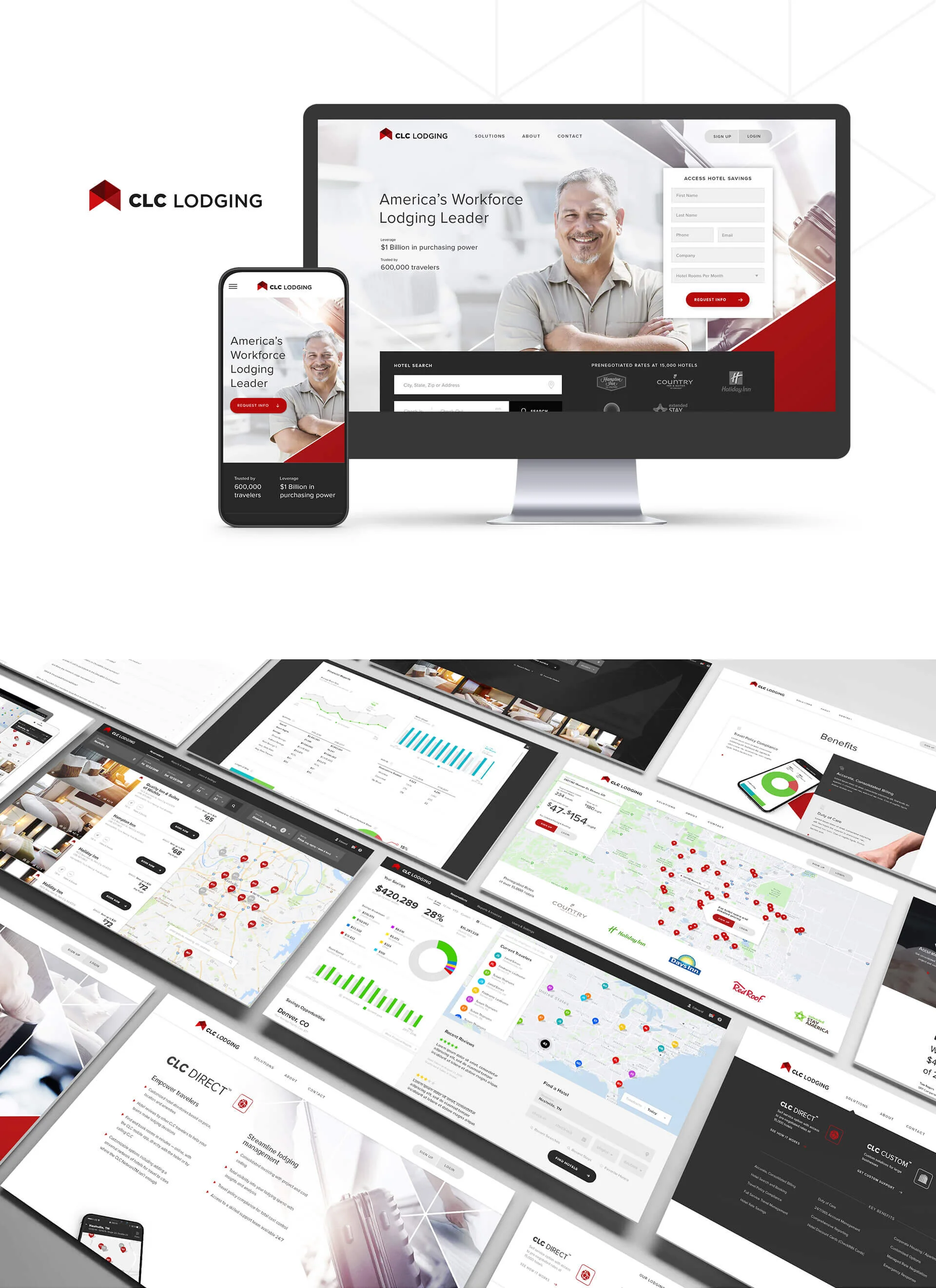
CLC Lodging
Project overview
Project: End-to-end product & UX for corporate lodging management — booking, approvals, invoicing, and reconciliation
Role: Senior UX Designer — led research, service design, interaction design, prototyping, usability testing, and rollout
Timeline: 10 weeks (discovery → prototypes → pilot → iterate → launch)
Team: Product Manager, Engineers, Sales SME, Finance/Accounting, Customer Success
Context CLC Lodging helps companies with mobile/field work (construction, utilities, sales) manage lodging spend, policy compliance, and invoicing. Prior processes were decentralized—employees booked their own hotels, producing hidden costs, invoice chaos, and heavy finance effort. The business needed a platform to enforce policy, consolidate billing, and reduce reconciliation overhead so customers could save at scale.
Problem
High hidden lodging costs from out-of-policy bookings and inconsistent rates.
Thousands of invoices and manual reconciliation work for finance teams.
Low adoption when strict enforcement blocked user choice; training seasonal/field staff was costly.
Prospects couldn’t see clear ROI or operational benefits, slowing sales.
Goals & success metrics
Reduce out-of-policy bookings by 40% (90 days)
Cut invoice reconciliation time by 50%
Improve booking completion rate by 25%
Increase demo requests from target verticals by 30%
Deliver UX patterns and tools that produce measurable company-level savings (multi-million annual impact for enterprise clients)
Approach
Stakeholder alignment — workshops with Sales, Finance, Ops to map cost drivers, key KPIs, and integration needs.
Field & user research — contextual interviews with travel bookers, finance teams, managers; service blueprinting of booking→invoice→reconcile.
Persona & journey mapping — Seasonal Booker, Finance Reconciler, Field Manager, Program Admin.
Design & prototyping — policy-first booking UI, consolidated invoicing, manager dashboard, and automated reconciliation flows.
Usability testing & pilot — tested with target users; piloted at three enterprise customers and iterated on metrics.
Research findings
Hidden-cost behavior: convenience-driven bookings multiplied into major annual expense.
Finance burden: manual invoice processing and mismatched project codes consumed many hours.
Adoption requires balance: soft guidance + one-click override/approval preserved usability while improving compliance.
Consolidated invoicing was highest-value feature for finance teams.
Design solutions
Policy-first booking: visible policy status, compliant suggestions, and one-tap request-for-approval when out-of-policy.
Consolidated, monthly invoicing: grouped charges by project with single invoice and CSV export for accounting systems.
Smart document & reconciliation tools: auto-match bookings to project codes, flag anomalies, and provide audit-friendly exports.
Manager dashboard: compliance metrics, pending approvals, cost-savings summaries, and drilldowns.
ROI-focused marketing pages: savings calculator and case snapshots to drive demo conversions.
Progressive onboarding and in-app guided training to shorten ramp for seasonal staff.
Measured outcomes (pilot → rollout)
Out-of-policy bookings: −42% in 90 days (pilot clients)
Invoice reconciliation time: −55% (pilot accounts)
Booking completion rate: +27%
Demo requests from target verticals: +33% via ROI-driven landing pages
Operational savings: aggregated enterprise clients reported multi-million-dollar annual savings from reduced lodging expense, lower labor for reconciliation, and fewer lost sales during peak—examples:
Mid-sized construction client: ~$1.2M annual savings (reduced overtime, fewer lost bookings, negotiated rates)
Multi-regional services provider: ~$2.6M annualized savings (consolidated billing + enforcement)
Pilot ROI: ~3x–4x within 12 months for early enterprise deployments
Deliverables
Service blueprint and journey maps
High-fidelity web & mobile prototypes (booking, approvals, dashboard)
Consolidated invoice format and reconciliation spec
Onboarding flows and training materials
Marketing ROI calculator and landing page copy
Analytics event map and KPI dashboard (policy compliance, invoice time, booking completes)
Handoff package: component specs, API needs, and dev tickets
Learnings & impact
Balancing policy enforcement with flexible approvals preserves adoption while delivering savings.
Consolidated invoicing and automated reconciliation deliver outsized operational value for finance teams.
Embedding a short guided onboarding accelerates seasonal staff competency and reduces training costs.
ROI-focused messaging (calculator + case examples) is essential to close enterprise deals.