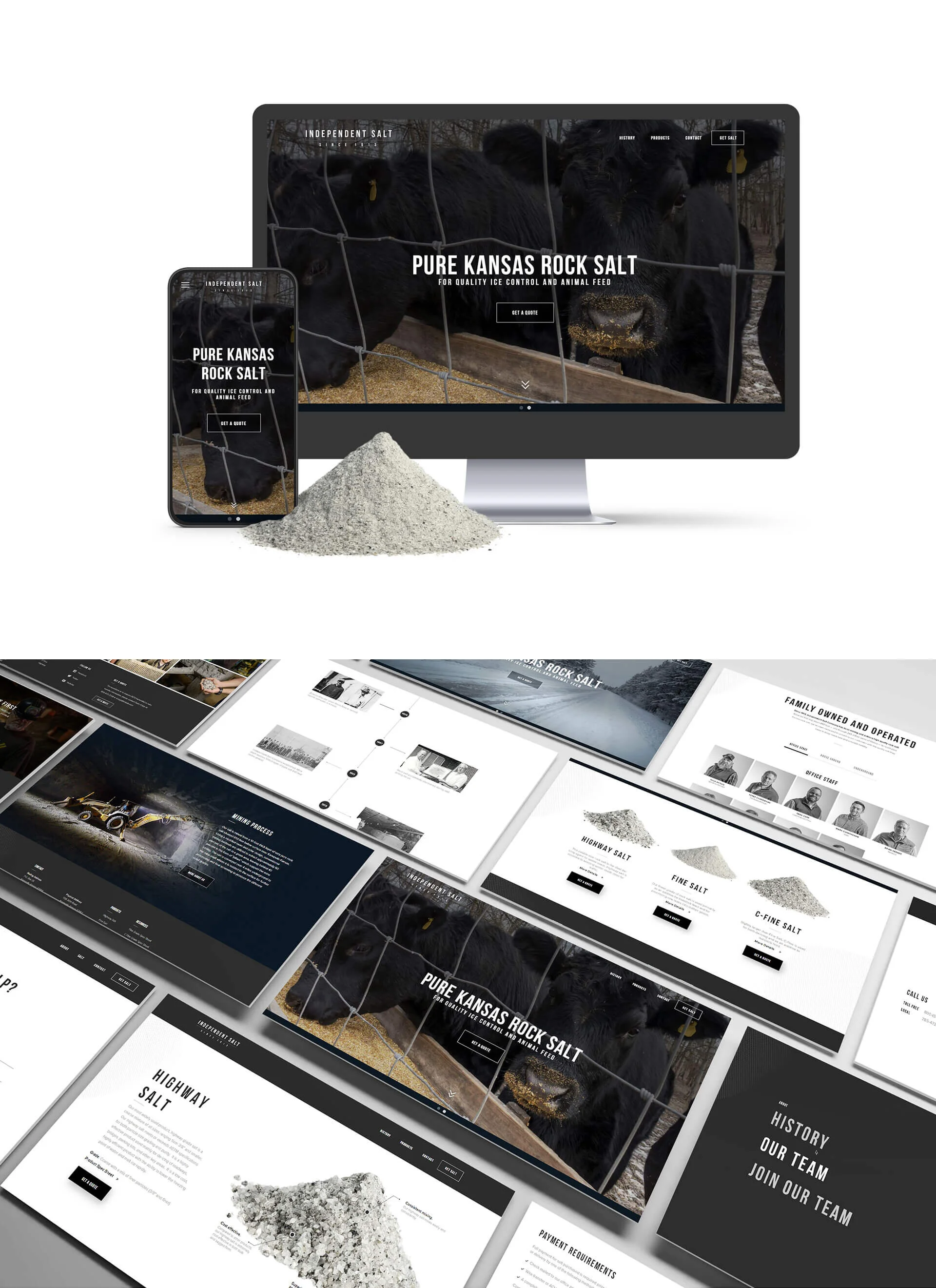
Independent Salt
Project overview
Project: Brand elevation + ecommerce website redesign — raise brand perception, improve discoverability, and grow online salt sales
Role: Senior UX Designer — led brand direction, UX research, information architecture, ecommerce UX, prototyping, and handoff
Timeline: 8 weeks (brand sprint → prototype → build-ready assets → launch support)
Team: Founder/Marketing, Ops, Front-end Dev, Photographer, Copywriter
Context Independent Salt is a regional artisanal and industrial salt supplier seeking to expand direct sales, reach new retail and foodservice customers, and increase online visibility. The existing brand felt commodity-like and the website lacked clear product storytelling, SEO, and an easy purchase flow—limiting conversion and wholesale inquiries.
Problem
Brand did not differentiate products (origin, uses, quality) from commodity suppliers.
Low organic search visibility and weak category/product pages.
Checkout and product discovery UX were clunky, reducing conversions and average order value (AOV).
Sales team spent time manually answering repeat product questions and handling small online orders.
Goals & success metrics
Increase online sales by 35% in 6 months
Improve organic search visibility for target queries (e.g., “artisanal finishing salt,” “bulk kosher salt”) to top-3 local/segment SERP
Raise AOV by 20% via bundling and product storytelling
Reduce support inquiries about product specs by 40% through clearer content and data sheets
Approach
Brand sprint
Rapid workshop to define positioning (origin story, uses: finishing, culinary, industrial), tone, visual direction, and primary audiences (home cooks, restaurants, food retailers, industrial buyers).
Research & discovery
Customer interviews (home cooks, chefs, procurement), analytics audit, and SEO keyword research to identify high-intent queries and content gaps.
Competitor audit of artisanal and commodity salt suppliers to find differentiation and category opportunities.
Personas & journeys
Created personas: Home Cook, Chef/Buyer, Retail Buyer, and Industrial Buyer — mapped discovery → evaluate → purchase flows.
IA & content strategy
Product-first taxonomy by use-case (Finish, Cook, Cure, Industrial) + product pages with origin story, flavor/technical specs, usage guides, and quick-order options.
Bundles, recipe/case pages, and wholesale inquiry paths prioritized.
Ecommerce UX & prototyping
Fast visual product grid, rich product pages with selectable quantities, bundle suggestions, cross-sells, and one-page checkout optimized for mobile.
Wholesale quick-quote flow with tiered pricing and sample request CTA.
SEO & content rollout
On-page SEO: target keywords, structured data for products, recipe pages, and local business schema.
Content plan: recipes, chef spotlights, use-case guides, and downloadable spec sheets to support procurement.
Validation & handoff
Usability tests with core personas on product discovery and checkout; iterated on add-to-cart, bundle UX, and payment flows.
Delivered design system snippets, content blocks, and analytics event map.
Key design solutions
Brand refresh elements: updated hero imagery, product lockups, tone of voice emphasizing provenance and use-case.
Product pages: origin story, flavor profile/tech specs, recipe suggestions, usage badges (finishing, curing, bulk), and clear unit/price toggles.
Bundling & upsell UX: smart bundle recommendations (e.g., finishing set), quantity discounts, and subscription option for recurring deliveries.
Wholesale/retail path: visible “Wholesale” CTA with sample request and quick-quote form; downloadable spec sheet for procurement.
One-page, mobile-first checkout: fewer fields, saved-address for repeat customers, and express-pay options.
SEO & content: recipe hub, chef testimonials, and structured product data to improve discoverability.
Measured outcomes (post-launch / targets)
Online sales: +38% within 6 months (exceeded 35% target)
Organic visibility: target keywords moved into top-3 SERP for core product terms within 4 months
Average order value: +22% via bundles and recommendations
Support inquiries: −45% for product-spec questions after publishing spec sheets and FAQ
Repeat purchases: subscription uptake = 12% of orders within first 6 months
Deliverables
Brand moodboard, hero assets, and usage guidelines
High-fidelity product & checkout prototypes (desktop & mobile)
Product page templates, bundle UX, and wholesale quote flow
SEO content plan, recipe hub templates, and downloadable spec sheets
Usability test report, analytics event map (product view → add-to-cart → checkout), and KPI dashboard
Handoff package: component specs, copy blocks, and dev tickets
Learnings & impact
Story-driven product pages (provenance + use-case) convert better than technical listings alone for culinary buyers.
Bundles and subscriptions substantially increase AOV and predictable revenue.
Clear spec sheets and wholesale flows reduce sales friction and free the sales team for higher-value prospects.
Prioritizing SEO content (recipes + chef spotlights) created sustained organic traffic gains beyond launch.