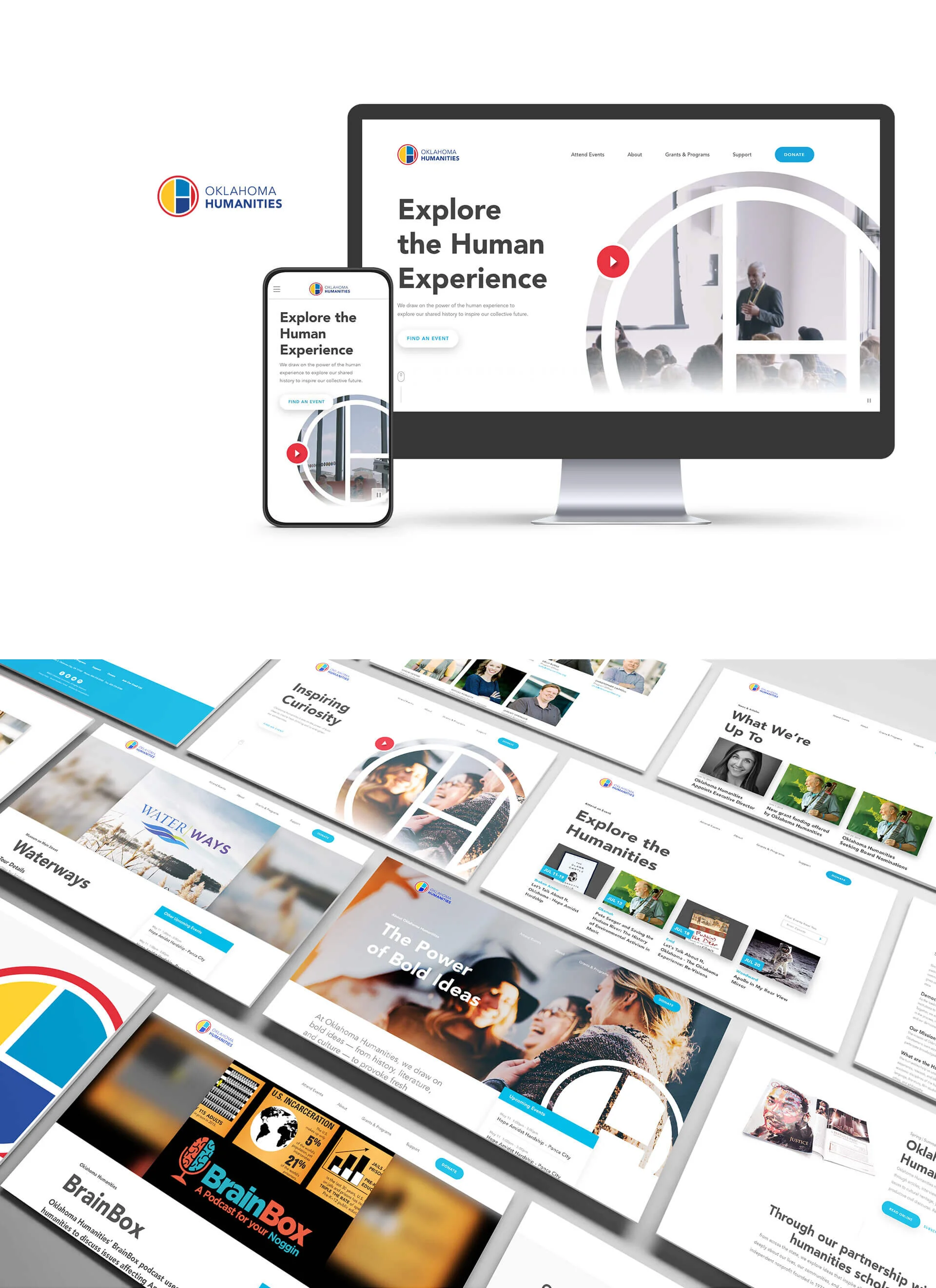
Oklahoma Humanities
Project overview
Project: Website & digital engagement redesign — expand reach of Oklahoma Humanities and drive public, educator, and community organizer engagement across the state
Role: Senior UX Designer — led research, IA, content strategy, interaction design, prototyping, usability testing, and implementation handoff
Timeline: 10 weeks (discovery → research → prototype → test → launch)
Team: Program Directors, Grants Admin, Communications, Front-end Dev, Content Strategist, Outreach & Analytics
Context Oklahoma Humanities supports public programs, grants, and educator resources that connect stories, culture, and civic life. The organization sought to expand statewide reach and increase participation in events, grant applications, educator resources, and donor support through clearer messaging, easier discovery, and audience-tailored engagement paths.
Problem
Limited reach: many communities and potential participants were unaware of local programs and resources.
Poor discoverability: events, regional programs, and grant opportunities were hard to find or filter by region/audience.
Low engagement funnel efficiency: event signups, grant inquiries, and resource downloads required too many steps and created drop-off.
Content not tailored: one-size-fits-all pages didn’t serve distinct audiences (public, educators, community organizers, donors).
Goals & success metrics
Expand reach: increase unique visitors from target regions by 35% in 6 months
Drive engagement: +30% event registrations and +25% educator resource downloads in 3–6 months
Grow grant participation: +20% qualified grant inquiries/applications year-over-year
Improve conversion: reduce drop-off in event registration and grant interest flows by 30%
Strengthen donor pipeline: +20% donation starts tied to program impact pages
Approach
Stakeholder alignment
Workshops with program leads, grants admin, outreach staff, and communications to prioritize audiences, regional goals, and required data feeds.
Mixed-method research
Stakeholder interviews (program directors, regional partners)
Contextual interviews with educators, community organizers, event attendees across urban and rural counties
Analytics audit and content inventory to identify gaps (event discoverability, resource findability, grant funnel)
Card-sorting and tree-testing to validate IA
Synthesis & personas
Personas: Community Organizer, K–12 Educator, Public Attendee, Donor/Philanthropist — mapped goals, trigger events, and ideal calls-to-action
IA & tooling
Audience hubs (Discover Programs, Teach & Learn, Apply for Grants, Support) plus Regional Map and Events Explorer with robust filters
Data center: downloadable regional impact packets, grant timelines, and program toolkits
Prototype & test
High-fidelity prototypes for desktop/mobile; moderated usability tests focused on finding events, applying for grants, and downloading resources
Implementation & measurement
Analytics event map and dashboards for regional visits, event registrations, downloads, grant starts, and donation conversions
Research findings (high level)
Regional discovery gap: rural users relied on regional partner pages and social channels; site lacked region-filtering and local landing pages.
Decision drivers: educators need standards-aligned materials and simple licensing; community organizers want clear application steps, timelines, and local case studies.
Friction points: grant interest forms and event registration flows required too many mandatory fields up front causing abandonments.
Trust levers: local success stories, measurable impact numbers, and partner endorsements drive participation and funding trust.
Design solutions
Region-first entry: interactive map and regional landing pages with local events, partner contacts, and recent program highlights.
Events Explorer: filterable calendar (county, audience, topic, date) with one-click RSVP and calendar export.
Grant hub: clear grant overview, timeline, example projects, FAQ, and a short “Start Interest” form that captures intent and routes to program staff for lightweight qualification before full application.
Educator hub: standards-aligned lesson kits, quick-download resource packs, and request-a-visit CTA with simplified intake.
Story & impact cards: short local case studies with metrics and CTA to “Bring this program to your community” or donate.
Outreach toolkit & partner portal: downloadable flyers, co-brandable assets, and partner submission forms to empower regional partners.
Conversion optimization: progressive forms, saved drafts for grant applications, and follow-up nurture sequences tied to initial actions.
Content governance & data sync: editorial calendar, region-owner roles, and automated data feeds for events and grants.
Measured / projected outcomes
Regional unique visitors: +35% in target counties within 6 months (via regional landing pages + partner outreach)
Event registrations: +30% within 3 months through Events Explorer and simplified RSVP flow
Educator downloads: +25% via curated resource hub and standards filters
Grant inquiries/applications: +20% qualified starts year-over-year with “Start Interest” funnel
Drop-off reduction: −30% abandonment in event and grant flows after progressive forms and clearer timelines
Donation starts: +20% via story-linked CTA placement and impact packets
Deliverables
Audience IA and regional map prototypes
High-fidelity screens: Events Explorer, Grant Hub, Educator Hub, Regional Landing
Persona pack and messaging matrix
Usability test report with prioritized fixes
Analytics event map and KPI dashboard templates
CMS templates and editorial calendar for regional content updates
Handoff package: component specs, accessibility checklist, and dev tickets
Learnings & impact
Regionally-tailored content and partner-enabled publishing significantly improve local reach and trust.
Progressive, light-touch grant intake increases qualified interest without intimidating applicants.
Events visibility and one-click RSVP reduce friction and boost attendance, especially in rural contexts where planning matters.
Partner toolkits and co-brandable assets empower local promotion and sustain ongoing engagement.