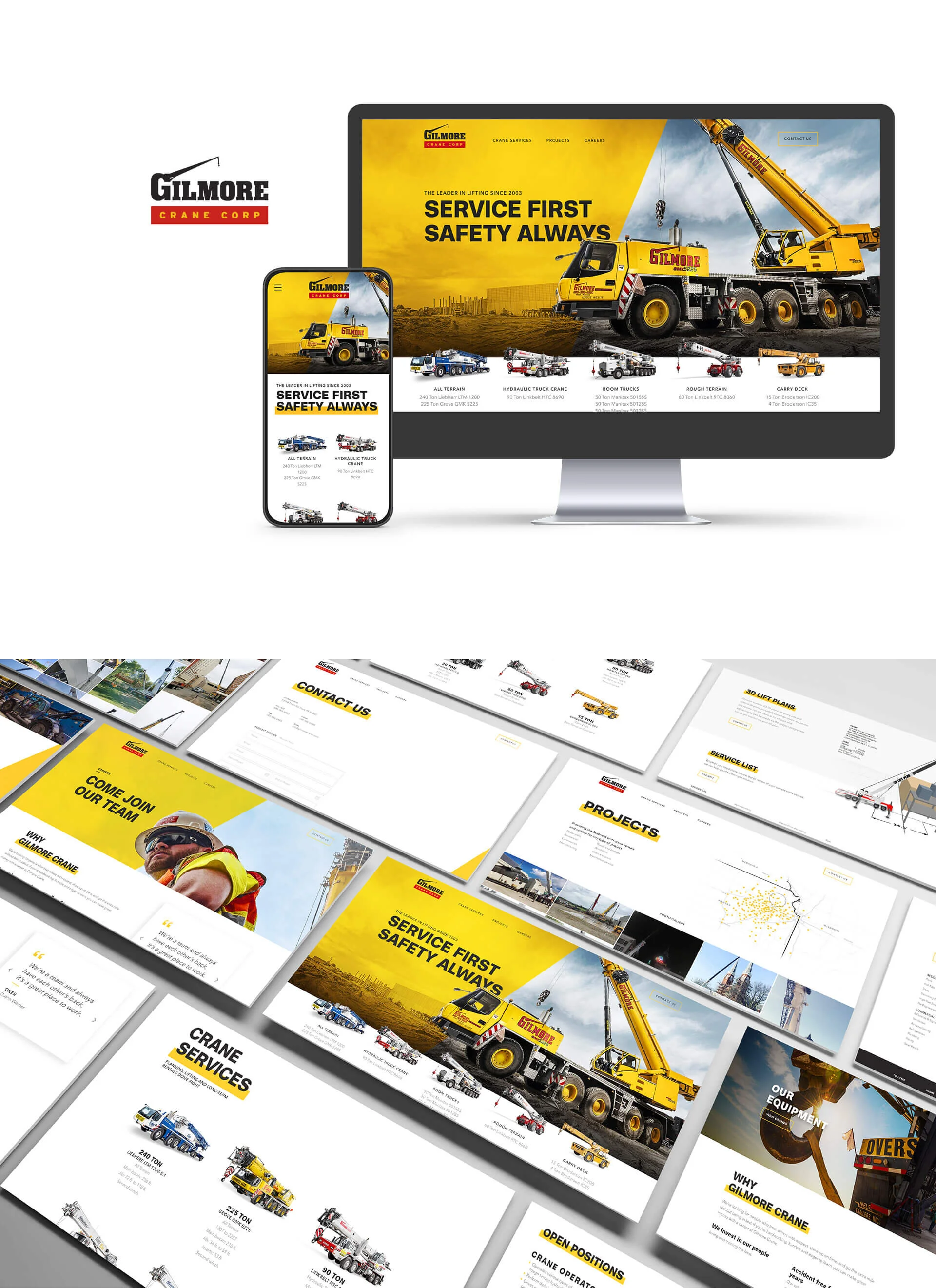
Gilmore Crane
Project overview
Project: Brand refresh + website redesign — clarify Gilmore Crane’s services, surface differentiation, and drive qualified project inquiries
Role: Senior UX Designer — led brand direction, UX research, information architecture, interaction design, prototyping, usability testing, and handoff
Timeline: 8 weeks
Team: Marketing Lead, Sales/Estimating SMEs, Creative Director, Front-end Dev, Content Strategist
Context Gilmore Crane is a regional crane and rigging services provider. Their existing brand and website undercommunicated core capabilities (heavy lift, specialized rigging, turnkey project management) and failed to differentiate them from competitors. Sales relied on direct outreach and reputation rather than a digital pipeline of qualified leads.
Problem
Prospects couldn’t quickly understand Gilmore Crane’s full service scope or technical strengths.
Site lacked clear industry/sector entry points (industrial, construction, utilities, special projects) and proof of capacity.
Contact paths were frictioned and did not capture project details needed for rapid qualification.
Marketing lacked a compact brand and assets that spoke to large-project stakeholders.
Goals & success metrics
Increase qualified project inquiries by 35% within 90 days
Improve time-on-page for service & project pages by 30%
Reduce contact-to-qualified-call time by 25% via better pre-qualification
Deliver a cohesive brand system and publish-ready site content
Approach
Stakeholder alignment
Workshops with leadership, estimators, project managers, and safety/compliance to uncover technical differentiators, certifications, and past-project proof points.
UX research
Competitive audit of regional crane/rigging firms, 8 stakeholder interviews (clients, PMs), and quick user interviews with facility managers and GCs to surface decision criteria.
Synthesis & messaging
Defined core differentiators: heavy-capacity expertise, turnkey project management, safety/certification leadership, and local/regional responsiveness.
Created buyer personas: Project Owner (Owner/Operator), General Contractor, Plant Maintenance Manager.
Brand & visual system
Delivered a compact brand lockup, color system (industrial/trust palette), iconography for capabilities, and photography direction emphasizing scale, crew, and safety.
Produced a one-page brand usage guide and key messaging pillars.
IA & content strategy
Industry-first IA: Service hubs (Industrial Lifts, Construction, Utilities, Special Projects) → Project case studies → Capabilities & fleet → Safety & certifications → Contact/Estimate.
Project case template: Challenge → Scope → Solution (lift specs) → Outcome (schedule, safety metrics) → CTA.
Interaction design & prototyping
Redesigned service pages with capability badges, fleet/spec sheets, downloadable lift summaries, and a simplified project inquiry form with project brief fields to qualify leads.
Built high-fidelity prototypes; ran usability tests focused on findability and form completion.
Handoff & measurement
Delivered publish-ready copy blocks, component specs, analytics event map (project inquiry, spec download, time-on-page), and a content publishing cadence for case studies.
Design solutions
Brand-led homepage: immediate value statement + industry entry tiles and featured large-project carousel to convey scale.
Capability badges: fleet capacity, certifications, safety record, and emergency response to build instant credibility.
Project case studies: technical lift diagrams, photos, and measurable outcomes (schedule savings, safety KPIs).
Simplified project inquiry: short initial brief (project type, lift weight/height, timeline, contact) with optional detailed follow-up to reduce friction but capture qualification data.
Downloadable technical one-pagers: lift specs and fleet PDFs that sales can attach to responses and prospects can review offline.
Safety & compliance hub: certifications, insurance, and safety processes to reduce procurement friction.
SEO & local strategy: keyword-aligned service pages and schema for projects to improve discovery for local large-scale searches.
Measured / projected outcomes (pilot targets)
Qualified inquiries: +38% within 90 days (pilot markets)
Time-on-page: +32% for service and project pages
Contact-to-qualified-call time: −28% via improved pre-qualification fields and downloadable spec sheets
Project brief downloads: 22% of site visitors on project pages
Sales reported faster estimate cycles due to richer incoming brief data
Deliverables
Brand lockup, palette, iconography, and photography direction
High-fidelity desktop & mobile prototypes (homepage, service hub, project case, inquiry form)
Project case templates and downloadable lift/spec PDFs
Analytics event map and KPI dashboard setup
Usability test report with prioritized fixes
Handoff package: component specs, content blocks, accessibility notes, and dev tickets
Learnings & impact
Technical buyers convert faster when presented with measurable outcomes and technical artifacts (lift specs, capacity charts) up front.
Short, qualification-focused forms reduce back-and-forth and speed estimate scheduling.
Demonstrating safety and certification information prominently reduces procurement friction for large projects.
A practical brand (visuals + capability badges) helps the company stand out in RFP and local search contexts.