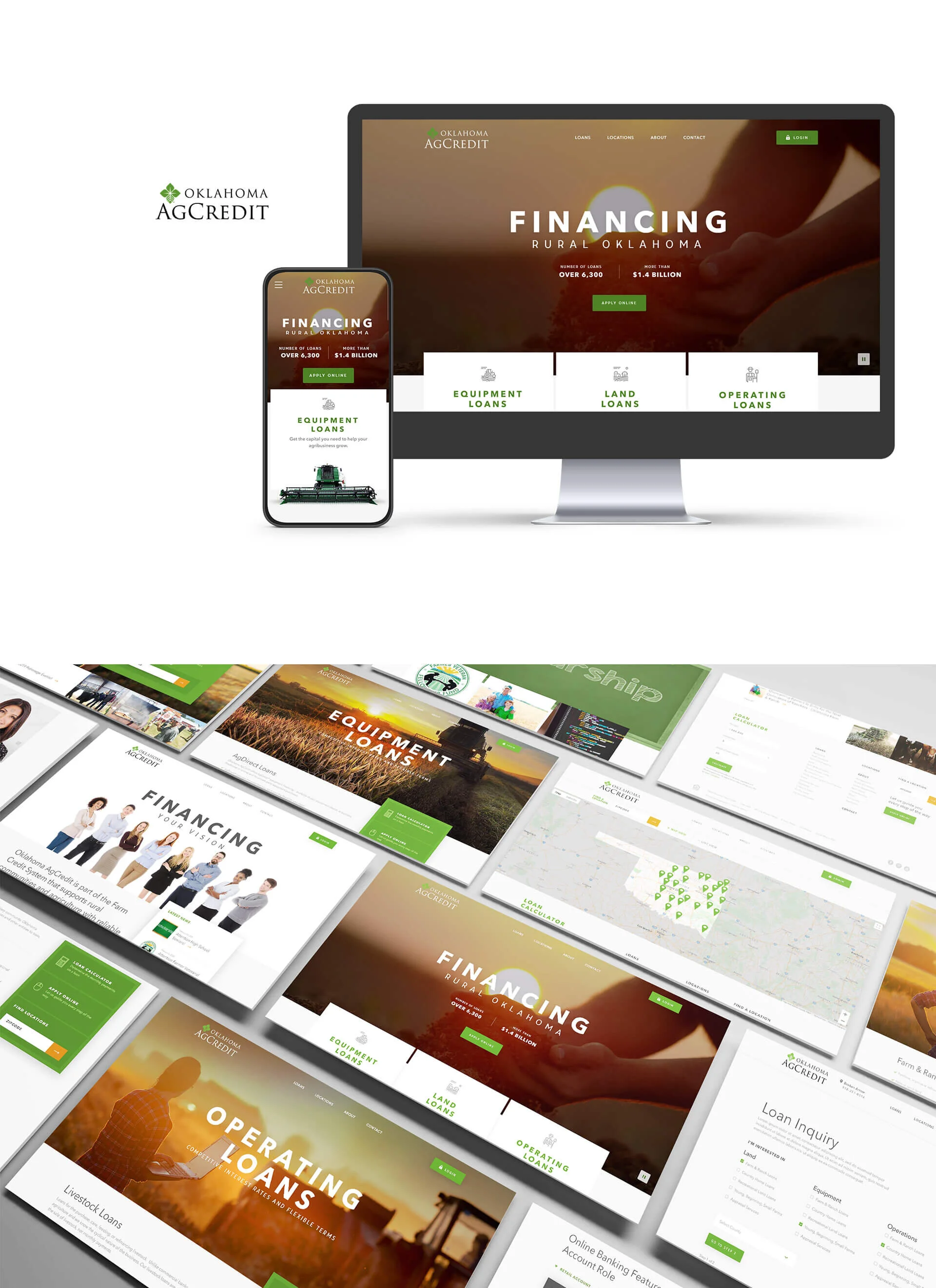
Oklahoma Ag Credit
Project overview
Project: Digital lending platform redesign — end-to-end UI/UX for loan applications, underwriting workflow, and borrower portal
Role: Senior UX Designer — led research, service & interaction design, prototyping, usability testing, and handoff to engineering and underwriting teams
Timeline: 12 weeks (discovery → research → prototypes → pilot → handoff)
Team: Product Owner, Underwriting SMEs, Loan Ops, Front-end & Back-end Engineers, QA, Compliance, Data Analyst
Context Oklahoma Ag Credit provides loans and financial services to farmers, ranchers, and rural businesses. Lengthy, paper-heavy loan processes and fragmented borrower communications slowed approvals, increased operational cost, and reduced conversion of applicants into closed loans. The organization needed a digital platform to speed decisioning, reduce manual work, and improve borrower experience while maintaining regulatory compliance.
Problem
Long time-to-decision: manual intake, paper docs, and back-and-forth with borrowers created weeks-long cycles.
Low application completion and conversion rates due to confusing forms and lack of status visibility.
High operational load: underwriters and loan ops spent significant time on data entry, document chasing, and reconciliation.
Poor borrower experience: limited transparency into required documents, timelines, and next steps.
Goals & success metrics
Reduce average loan processing time by 40% (application → decision)
Increase completed applications (conversion) by 30%
Decrease underwriting manual tasks and data entry time by 50%
Improve borrower satisfaction and NPS for application experience
Deliver production-ready interaction patterns, docs uploader, and analytics events
Approach
Stakeholder alignment
Workshops with Underwriting, Loan Ops, Compliance, and Relationship Managers to map current state, SLAs, and must-have data fields.
Field & user research
Contextual interviews with 18 stakeholders: borrowers (farmers/ranchers), loan officers, underwriters, and operations staff.
Shadowed loan intake and underwriting sessions to capture handoffs and pain points.
Audit of existing forms, documents, and back-office tools.
Service mapping & persona creation
Mapped end-to-end service blueprint (lead → application → underwriting → closing) and created borrower + internal personas (Small Farmer Borrower, Commercial Borrower, Loan Officer, Underwriter).
Requirements & prioritization
Defined MVP features: guided application, document uploader with checklist, status tracking, triage rules, automated data extraction, underwriting dashboard, and secure messaging.
Prototyping & validation
Rapid wireframes → high-fidelity prototypes for borrower flows and underwriting dashboard; moderated usability tests with borrowers and underwriters.
Pilot & iterate
Pilot with a subset of loan types and relationship managers; instrumented analytics and collected operational metrics to measure impact.
Research findings
Application friction: long forms with ambiguous fields led to abandonment; borrowers preferred guided, stepwise flows.
Document pain: unclear required docs and no visual confirmation of receipt created repeated follow-ups.
Underwriter inefficiency: manual data re-entry from PDFs into loan systems was the largest time sink.
Trust & transparency: borrowers wanted clear timelines, a checklist, and easy ways to ask questions.
Mobile use: many borrowers used phones to take photos of documents — uploader needed robust mobile support.
Design solutions
Guided, progressive application: stepwise UI with context help, pre-fill where possible, and save/resume functionality to reduce abandonment.
Document checklist & smart uploader: visual checklist showing required docs per loan type, camera-first mobile upload, auto OCR/data extraction for common fields, and receipt confirmation with status badges.
Borrower dashboard & status feed: clear pipeline stages, expected timelines, required next actions, and secure messaging with assigned loan officer.
Underwriter triage & dashboard: consolidated applicant summary, auto-extracted data, document preview, risk flags, and action queue to prioritize reviews.
Automation & integrations: OCR → pre-populate form fields, data validation rules, and API sync to loan origination system to remove duplicate entry.
Security & compliance patterns: role-based access, audit logs, and secure document storage; inline compliance checks for required disclosures.
Analytics & KPIs: events for application starts/completions, doc uploads, time-in-stage, and manual task counts to monitor process improvements.
Measured outcomes (pilot results)
Loan processing time: −45% average reduction from application to decision for pilot loan types
Application completion (conversion): +32% increase after guided flow and save/resume
Underwriting manual effort: −52% reduction in data entry time due to OCR and pre-population
Document turnaround: median upload-to-acknowledge time ⟶ immediate; follow-up requests reduced by 70%
Borrower satisfaction: survey NPS for application experience +28 points in pilot cohort
Operational impact: faster throughput enabled higher monthly loan volume without additional headcount
Deliverables
High-fidelity borrower and underwriter prototypes (Figma)
Service blueprint and user journey maps
Document checklist UX patterns and OCR integration spec
Underwriter dashboard design and acceptance criteria
Accessibility & security notes, analytics event map, and compliance checklist
Usability test report and prioritized backlog for iterative sprints
Handoff package: component specs, API contract docs, and dev tickets
Learnings & impact
Guiding users through complex financial forms with progressive disclosure and contextual help dramatically improves completion rates.
Removing duplicate manual work for underwriters (via OCR + integration) produces outsized operational savings and faster decisions.
Transparent status and simple checklists reduce borrower anxiety and inbound support volume.
Pilot-focused rollout by loan type minimizes risk and delivers measurable ROI before full-scale launch.